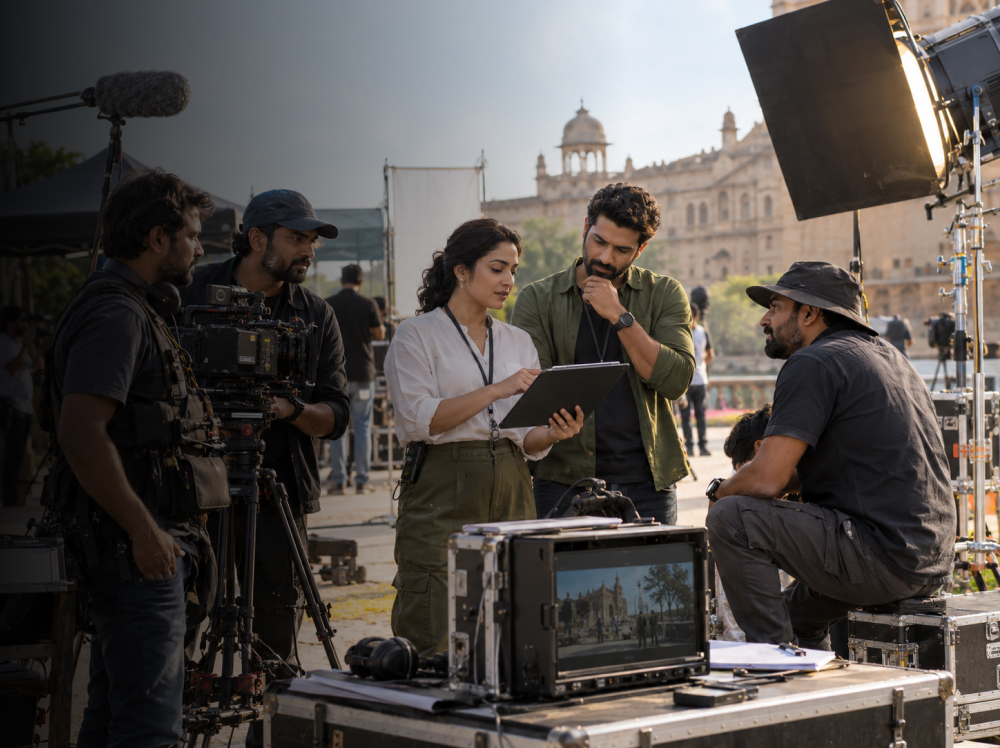
India's creator base grew from 0.96 million in 2020 to 4.12 million in 2025, according to Understanding the Canvas of India's Creator Economy, a July 2026 report from the Indian School of Business and Hashfame. The Union Cabinet has approved a National Centre of Excellence for animation, visual effects, gaming, comics and extended reality in Mumbai, since named the Indian Institute of Creative Technologies. In the UK, a 2026 study by ScreenSkills and the BBC reported growing convergence between creators and the film and television sector. That is a UK finding, useful here as a trend signal only.
A content creator career path no longer has to end at brand deals. What "filmmaker" means here: the content creator vs filmmaker line gets drawn in different places, so to be clear, this guide uses filmmaker for anyone who works on films, series and ads for a living, from editors and camera crew to writers, actors and directors. Becoming a director is a different route from joining a production in a crew role, and section 1 covers both. This guide to the content creator to filmmaker move then covers which skills cross over, how to present them, and what to learn before a first set.
Can You Go From Content Creator to Filmmaker in India?
Yes. A creator in India moves into film or OTT work by one of three routes: on camera, by auditioning as an actor; behind the camera, by joining a unit in an entry role in editing, camera, writing, production or sound; or as a director, by making short films of their own while learning how a set runs.
The content creator vs filmmaker difference comes down to how the work is organized. A content creator usually does most jobs on a video themselves and answers to an audience. A filmmaker usually works in a defined role inside a larger production, and answers to a director, a head of department or a producer, and to a schedule. On small independent films one person may hold two or three roles, but each role is still named and credited.
Most youtuber turned filmmaker coverage is about well-known names who became directors or leads, and the influencer to actor route runs through auditions like any other actor's. For most creators, the realistic content creator to filmmaker step is a named role on someone else's production.
How Does a Content Creator Become a Film Director?
A content creator becomes a film director by directing finished short work, such as short films, micro dramas and branded films, while spending time on other people's sets to learn how a unit runs. For the content creator to filmmaker move into directing, a channel already gives you scripting, shot planning, editing and a sense of what holds an audience. Directing a film adds what a channel rarely asks for: developing a longer screenplay, directing actors and blocking a scene, working with a DOP and heads of department instead of doing their jobs yourself, holding continuity across a shoot, and answering to a producer on schedule and budget.
On Indian sets, the usual way to get that set time is to assist a director, starting as a junior AD. For directing, the showreel vs portfolio question tips toward the portfolio, because a producer wants to watch a finished short from start to end. A youtuber turned filmmaker, in the directing sense, has completed films to show with a direction credit on each. Our guide to filmmaker jobs in India explains the director's role alongside the producer's and the DP's.
Which Creator Skills Transfer to Which Film Roles?
A reel or YouTube editor can realistically go for assistant editor work on films and series, and for editor work on micro dramas, short films and branded content. The table maps the other creator tasks to entry roles.
| What you do as a creator | What it shows | Nearest entry role on a production | What you still need to learn |
| Cut your own videos in Premiere Pro or DaVinci Resolve | You can build a scene to pace and sync sound | Assistant editor; editor on micro dramas and branded films | Syncing multi-camera footage, logging clips, handing over a clean timeline |
| Shoot on a mirrorless camera or phone and set your own lights | You can frame, expose and light a small setup | Assistant cameraman | Slating, lens changes, focus marks and camera reports under a DOP |
| Write sketches, hooks and voice-over scripts | You can write lines people say out loud | Script writer on micro dramas and branded content | Screenplay format, longer story arcs, rewriting to someone else's notes |
| Plan your own shoots: locations, people, dates | You can get a shoot to happen on the day | Production assistant | Call sheets, location permissions, daily reports |
| Record and clean up dialogue with a lav or shotgun mic | You can capture usable dialogue | Sound assistant | Boom operation, timecode, sync sound, sound reports |
| Perform sketches or characters to camera | You are at ease on camera and can time a line | Actor, through auditions | Hitting marks, continuity across takes, self-tapes and callbacks |
The Media and Entertainment Skills Council publishes occupational standards for several of these roles, including Editor, Assistant Cameraman, Production Assistant and Sound Assistant, on its qualification packs page. Titles vary by language industry and by production. On larger camera teams, entry-level roles can include the clapper loader (the 2nd AC), working below the focus puller (the 1st AC).
For many creators, editing is the most direct content creator to filmmaker bridge. If you're scanning video editor jobs in film industry listings, search for assistant editor first. Our guide to post-production jobs explains the ladder above it, and our guide to film industry skills covers what every role needs.

How Do You Turn Creator Work Into a Film Portfolio?
You turn creator work into a film portfolio by rewriting each video as a credit: the project, your exact role, the dates, and what you physically did on it. Then you cut a short showreel for one role only. This is where the content creator vs filmmaker gap shows: a channel proves that people watched, and a credit list proves what you can be handed.
- Pick one role. A reel that mixes editing, shooting and acting tells a production nothing about which job to give you.
- Rewrite each video as a credit line. State your role, the project, who it was made for, the month and year, and the tools you used.
- Separate solo work from client work. Label self-produced videos as such, and say so when a brand or agency briefed you.
- Move the numbers down. Views and subscriber counts go last, after the craft details.
- Cut the reel for that role. An editor's reel shows cuts. A camera reel shows shots.
An invented example of step 2:
Before: Coorg travel vlog, 1.2M views
After: Editor and camera, "Monsoon in Coorg" (self-produced travel film, 9 minutes), August 2025. Shot on a mirrorless camera, cut and graded in DaVinci Resolve.
Artisty puts these fields in one place. The Projects section of your profile takes the project name, the employer or production house, your role, the dates and a description of your contribution, with your Instagram, YouTube and showreel links beside it.
Showreel vs Portfolio: Which Do You Need?
You need both, and they do different jobs. A showreel is a short edited video that proves the quality of your work in one role. A portfolio is the full record behind it: complete pieces, credits, dates and your contribution on each. In the showreel vs portfolio balance, editors and writers lean on the portfolio, because a montage hides the decisions made across a full scene. Camera and acting lean on the reel.
What Should a Production Be Able to See in Your Reel?
A production assessing a creator's work for an editor or assistant role needs four answers from it: which single role the reel is for, what the person did on each clip, whether any piece was made to someone else's brief, and where a full, uncut piece can be watched. Those four answers turn a content creator to filmmaker profile from a channel link into something a head of department can assess.
What Gaps Do Creators Need to Close Before a First Set?
A follower count does not get you cast or hired on its own. Casting directors in India have said so publicly: one told The Hollywood Reporter India he would be heartbroken if anyone were casting from Instagram, and an actor and casting director told Bollywood Hungama that casting decided on follower numbers is the problem, whatever the performer's background. What you put in front of them is an audition, a self-tape and a credit list.
The hardest adjustments for a creator on a first set come from working inside a unit, and equipment is the smaller part. The content creator to filmmaker gap shows up in five places.
| Gap | On your channel | On a set |
| Whose decision | You choose the shot, the cut and the upload date | You carry out a director's or head of department's call |
| Continuity | One sitting, one setup | Scenes are shot out of order, and props, light and performance must match across takes |
| Story length | A hook holds a viewer for seconds | An episode or a feature holds a story across many scenes |
| Handover | You export a finished file | You hand an organized project to the next person in the chain |
| Terms | Informal agreements, if any | Role, dates and credit agreed in writing before the shoot |
The ScreenSkills and BBC study of UK creators also found that legal, intellectual property, financial and employment skills matter more as a creator's work grows. A youtuber turned filmmaker makes each of these adjustments sooner or later.
KalaAi, Artisty's AI feature, verifies skills through a skill check and a short KalaAi interview, and a pass adds a verified badge to your profile.

Content Creator to Filmmaker: What Should You Do in the Next 30 Days?
The sequence is the same for a youtuber turned filmmaker and for an Instagram editor after a first assistant job: four steps, a week each.
- Week 1: choose. Pick one role from the table, and the city and languages you can work in.
- Week 2: rebuild. Settle the showreel vs portfolio question for your role, rewrite your strongest videos as credit lines, then cut the reel. If you're working out how to make a showreel with no experience on a set, labeled self-produced work counts.
- Week 3: publish and verify. Add your role, projects, reel, languages and city to your Artisty profile, and take the KalaAi skill check and interview.
- Week 4: get one crew day. Assist on a short film, a student film, an ad or a micro drama, in the role you chose.
Creators find film work in India through crew they have already worked with, openings posted by production houses, casting calls, and platforms such as Artisty, where productions search profiles by role, city and language. Micro dramas shoot vertical and fast, which makes them the closest format to creator work, and our guide to micro drama jobs in India covers how those productions hire. Once you have that first day, the 90-day plan in our guide to jobs in the film industry for freshers takes over.
Conclusion
The skills were never the obstacle. A creator who shoots, cuts, writes and schedules their own videos has already practiced part of several entry roles on a set. The move from content creator to filmmaker stalls on proof: views describe an audience, and a production needs to know what one person did, on which project, and when.
The youtuber turned filmmaker stories that make the news skip this step. So pick the one role you're going for, add each video as a dated credit with what you did on it, attach your reel, and take the KalaAi skill check: create your Artisty profile.
Frequently Asked Questions
Content creator vs filmmaker: what is the difference?
A content creator plans, shoots, edits and publishes a video alone, for an audience they built. A filmmaker, in the broad sense, does one defined job on a film, series or ad as part of a unit. The content creator vs filmmaker difference in hiring is proof: reach for one, credits for the other.
Do followers help you get cast in films or web series in India?
Followers can get your name noticed, but they do not replace an audition. Casting directors in India have said publicly that they cast on performance and suitability for the role. Prepare a self-tape, a short acting reel and a list of what you have performed in.
How long should a showreel be?
Short enough to be watched in full. Open with your strongest work for the one role you want, and cut any clip that repeats a skill you have already shown. The showreel vs portfolio split helps: the reel stays short because the portfolio holds the full pieces.
How to become a filmmaker without film school if you already make videos?
No single qualification is required for film crew roles in India, and many crew enter through on-set assistantships. For the content creator to filmmaker route, choose one role, turn your videos into dated credits, and get a first day on a real shoot. Our guide to jobs in the film industry for freshers covers the no-experience route step by step.
Do you need to move to Mumbai to work in films?
No. Mumbai is the center for Hindi film and advertising, but Hyderabad, Chennai, Kochi, Bengaluru and Kolkata each have working industries in their own languages. Start where you already have the language and the contacts. Our guide to the regional film industry in India maps the hubs.