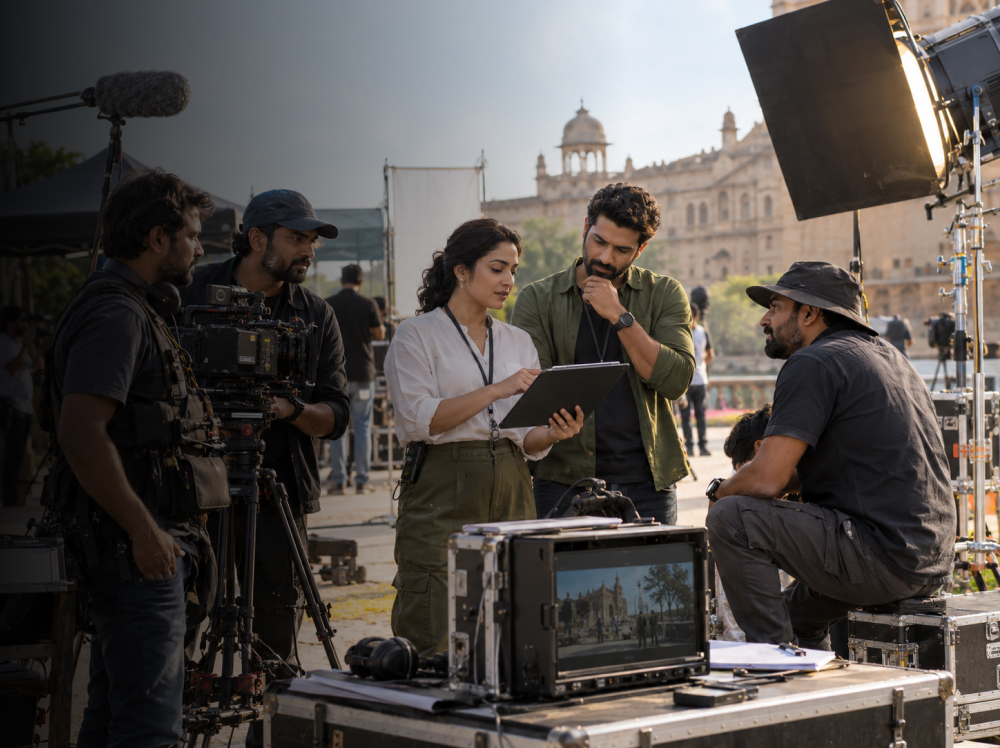
Many entry routes into film crew work are assistant or trainee roles where prior professional credits may not be required, although requirements vary by production, department and location. You can get a job in the film industry with no experience by showing proof of work, being reliable on your first set day, and building credits one project at a time.
If you are working out how to get into the film industry, here is the six-step roadmap:
- Pick one role and one city or language. “Camera attendant, Telugu and Hindi, Hyderabad” is easier to hire than “anything in films”.
- Make proof of work. Crew on student films and short films, and learn the basic tools of the role you picked.
- Build a profile that shows it. Put your role, languages, city, reel and dated credits in one place, such as a free Artisty profile.
- Get your first set day. Take a production assistant or trainee role on any real shoot you can reach.
- Connect one level up. Stay in touch with the crew who supervised you on set.
- Follow up and keep your availability current. Productions often lock crews before the shoot, so dated availability helps you get booked.
Can freshers get jobs in the film industry without experience?
Yes. Some productions hire assistants and trainees alongside experienced crew, creating entry points for people building their first credits. For entry-level roles, productions may place significant weight on reliability, availability, basic role-specific skills and references, especially when a candidate has limited credits.
A film degree can provide technical training and industry connections, but some entry-level crew pathways also begin through short courses, student productions, assistant roles or independent projects. Starting in the film industry with no experience depends more on the first project you can reach than on a certificate. For structure without a full degree, FTII runs short courses in several cities, listed on its courses page.
What entry-level film jobs require no experience?
Entry-level film jobs are the assistant and trainee roles at the base of each on-set team and in post-production, which can provide entry points into different departments. India's Media and Entertainment Skills Council (MESC), the government-backed skills body for the sector, publishes occupational standards that define several of these roles, including Production Assistant (MES/Q2805), Spot Boy (MES/Q2810), Assistant Cameraman (MES/Q0903) and Sound Assistant (MES/Q3403), on its qualification packs page. These standards describe what each role involves and the skills it calls for. They do not set hiring conditions, and what a production asks for varies by project.
This table shows what common entry-level film jobs involve on day one and where they can lead.
| Role | What you do on day one | Possible next roles |
| Production assistant | Hand out call sheets, guide cast and crew between locations, track paperwork | Production coordinator, production manager |
| Trainee or 4th AD | Manage background actors, carry script pages, relay cues from the 1st AD | 3rd AD, 2nd AD, 1st AD |
| Camera attendant | Carry and set up camera cases, stands and batteries | Clapper loader (2nd AC), then focus puller (1st AC) |
| Light assistant | Rig and move lights and cables under the gaffer | Electrician, then gaffer |
| Art assistant | Dress sets, source and track props between takes | Assistant art director, art director |
| Assistant editor or roto artist | Back up footage, sync sound, prepare timelines; or isolate objects frame by frame for VFX | Editor; compositor |
On Artisty, work is listed as jobs, gigs, collaborations and internships, so you can show availability for internships and short gigs alongside the role you want.
Production assistant roles
A production assistant supports the production team across a shoot, from logistics to paperwork. The MESC standard for the role covers coordinating production activities, managing content archives, and assisting performers and crew (MESC standard MES/Q2805).
On a typical day, you arrive before call time, check that everyone on your list has the call sheet, and stay reachable until pack-up. The call sheet, prepared by the 2nd assistant director, lists the day’s scenes, locations, and call times. It can be a relatively broad entry point for people who have not yet committed to a specialist department.
Trainee and departmental assistant roles
Trainee and departmental assistants learn one craft from the inside. A trainee or 4th AD works under the assistant director team, which runs the floor and keeps the shoot on schedule, though not every unit runs a full four-level AD chain. In camera, the usual route runs from camera attendant to clapper loader (2nd AC), who marks each take with the slate, and then to focus puller (1st AC). Our guides to film production jobs in India and post-production jobs cover each role in more detail.
What skills can you transfer into film production?
Many freshers already have skills a unit needs; they have just not used them on a set. Matching past work to a set role is an underused answer to how to get into the film industry, and it widens the jobs in the film industry for freshers you can apply for.
| If you have worked in | You already know | Entry role that uses it |
| Event management or college fests | Scheduling, vendor handling, moving crowds | Production team, trainee AD |
| Hotels, restaurants or retail | Staying calm under pressure, handling people all day | Production team, costume assistant |
| IT support or data entry | File handling, backups, careful logging | Data wrangler trainee, assistant editor |
| ITI trades such as carpentry or electrical work | Hands-on building and wiring | Set construction, light assistant |
| Two or more Indian languages | Working across languages | Trainee AD on regional shoots, dubbing support |
On your profile, write “scheduled 12 performers across a three-day college fest”, not “good with people”.
How do you create a film profile without credits?
You create a film profile without credits by showing work from your own projects and your contribution in other people’s projects, labeled honestly. It is the first hurdle for anyone entering the film industry with no experience. What counts as proof depends on the role. An aspiring editor shows short cuts, a camera aspirant shows a short reel that opens with the best-lit shot, and someone aiming for production shows the schedules they prepared for a short film.
For jobs in the film industry for freshers, a dated credit list with your exact role on each project matters more than a long one. Artisty puts your role, reel, languages, city and dated credits on one profile that productions can search. KalaAi, the AI layer inside Artisty, verifies your skills through a skill check and a short interview, and a pass earns a verified badge. For a fresher, that badge gives a production something to check before the credit list gets long.
Student films, short films and volunteer projects
Student films, short films and volunteer projects can build credits before paid work, where the terms, credit and expectations are clear. Before you agree to unpaid work, confirm in a message how long the shoot runs, what your role is, how you will be credited, and whether food and travel are covered. Film school students at FTII, SRFTI and Whistling Woods crew each other’s diploma films and often need extra hands in production, sound and art. Credit this work accurately: “production assistant, diploma short film, 2026” is a real credit, and an inflated title gets checked.

Where should freshers search for jobs in the film industry?
Search job boards, production house careers pages, film school short courses and crew platforms. Job boards list plenty of jobs in the film industry for freshers, but most results are salaried media roles such as video editor or studio coordinator. Those are real openings. On-set work is usually hired per production, so entry-level film jobs on a shoot rarely appear as permanent listings.
Student films, short films and volunteer projects can build credits before paid work, where the terms, credit and expectations are clear. Before you agree to unpaid work, confirm in a message how long the shoot runs, what your role is, how you will be credited, and whether food and travel are covered.
Production houses post internships and trainee openings on their own careers pages. Artisty is built for project hiring productions search profiles by role, city and language, and your profile stays visible between shoots. Micro dramas and smaller regional productions are also worth a look, as our guide to in-demand jobs in the film industry explains.
How do you network when you do not know anyone?
Network one level up. People who have directly supervised your work can become useful contacts for future projects because they have firsthand knowledge of how you work, such as the 2nd AD or the clapper loader. They hear about the next project early.
Before your first set, spend time at events where filmmakers, producers, industry professionals and creators may gather, such as the MAMI Mumbai Film Festival, IFFK in Thiruvananthapuram, and screenings and workshops in your city. Film Bazaar, run by NFDC in Goa, is a film market that brings filmmakers together with co-producers, sales agents and distributors; it is an industry event, not a job fair. None of these is a hiring channel in itself. Use them to meet working crew and ask one specific question about their job rather than asking for work. Most advice on how to get into the film industry says "network"; in practice it means turning one conversation into one set day.

What mistakes should first-time applicants avoid?
Most first-timer mistakes cost a second call, and all of them are avoidable.
- Be cautious of anyone asking you to pay for a mandatory 'artist card', audition, registration or guaranteed placement. Verify any requirement directly with the production or relevant association before paying.
- Applying for “any role”. Name one role, and one you can fall back on.
- Leaving out dates. A profile without availability is hard to book.
- Confirming and then not showing up. Units plan the day around headcount, and one no-show can end referrals from that crew.
What should you do during your first 90 days?
Your first 90 days decide whether one set day turns into a second, which is the part most advice on how to get into the film industry skips. Treat them as three phases.
What to do on your first set
For anyone starting in the film industry with no experience, the first set day is a trial run, and the crew is watching how easy you are to work with.
Before call time
- Confirm the location and your reporting time on the call sheet.
- Confirm who you report to on the day, by name and phone number.
- Ask whether there is a dress code or safety requirement, such as closed shoes on location or ID at a studio gate.
On set
- Report to your designated supervisor as soon as you arrive.
- Stay within the tasks you were given, and ask before taking on anything outside your role.
- Handle equipment only when the team that owns it asks you to.
- Keep communication short and clear, and repeat instructions back when you are unsure.
- Stay reachable until your supervisor releases you.
After wrap
- Confirm how your credit will read, and note it down.
- Ask whether the team wants your availability for future shoots.
- Send a short message the next day with your name, the project, what you did and your next free dates.
Your 90-day plan
(Same table as before, with one row changed so it doesn't repeat the first-set list. Days 1 to 30, Learn the unit:) Learn who reports to whom, how your supervisor wants updates, and how the unit's day runs.
For the full map of roles across a production, see our guide to film industry jobs.
| Days | Focus | What to do |
| 1 to 30 | Learn the unit | Arrive before call time, learn who reports to whom, ask your supervisor how they want updates |
| 31 to 60 | Collect proof | Log every task you handled, ask for a reference at wrap, keep stills or credits you are allowed to share |
| 61 to 90 | Line up the next project | Add the new credit and reference to your Artisty profile, update your availability, message the crew one level up about their next shoot |
For the full map of roles across a production, see our guide to film industry jobs.
Why your first credit can help you get the next opportunity
For freshers, the first credit does more work than any application. It is proof that you turned up at call time and left a crew willing to call you back. Every step in this roadmap points at that moment, from picking a role narrow enough to be hired for to staying in touch with the crew one level up.
The second job often starts with how the first one ended. Message the crew the next day and add the credit to your profile while the details are fresh. Jobs in the film industry for freshers go to people who are easy to find and easy to check.
Artisty is built for that stretch between shoots. It puts your role, credits and availability on one profile productions can search, and KalaAi verifies your skills so a short credit list still carries weight. Create your Artisty profile now.
Frequently asked questions
Do I need a film school degree to get a job in the film industry?
No. A degree is not required for entry roles such as production assistant, trainee AD or camera attendant. Film schools such as FTII, SRFTI and Whistling Woods give technical grounding and peers, which helps later. Many working crew learned on set as assistants.
Do I need a union card to work on a film set in India?
It depends on the craft and the city. Several crafts in Mumbai and the southern film industries have their own associations, and their rules differ. Before your first shoot, ask the production manager or your head of department whether that production needs you to hold a card. Never pay an agent who offers one; confirm directly with the association.
Which city should i target for my first film job?
Mumbai remains a major production center for Hindi-language entertainment and advertising, while Hyderabad, Chennai and Kochi are important production centers for Telugu, Tamil and Malayalam work respectively.
Can freshers get paid in the film industry?
Many paid jobs in the film industry for freshers offer a daily or project fee, while student and short film work is often unpaid. Pay depends on the type of production, the city and the role. Before the shoot, ask what the fee is, when it will be paid, and whether meals and travel are covered, and get the answer in writing.
Should I do an internship or start as an on-set assistant?
Both work. An internship at a production house teaches the office side of a project, such as scheduling and paperwork. Assisting on set teaches a craft and puts your name on the call sheet sooner, so start there if your goal is an on-set role.