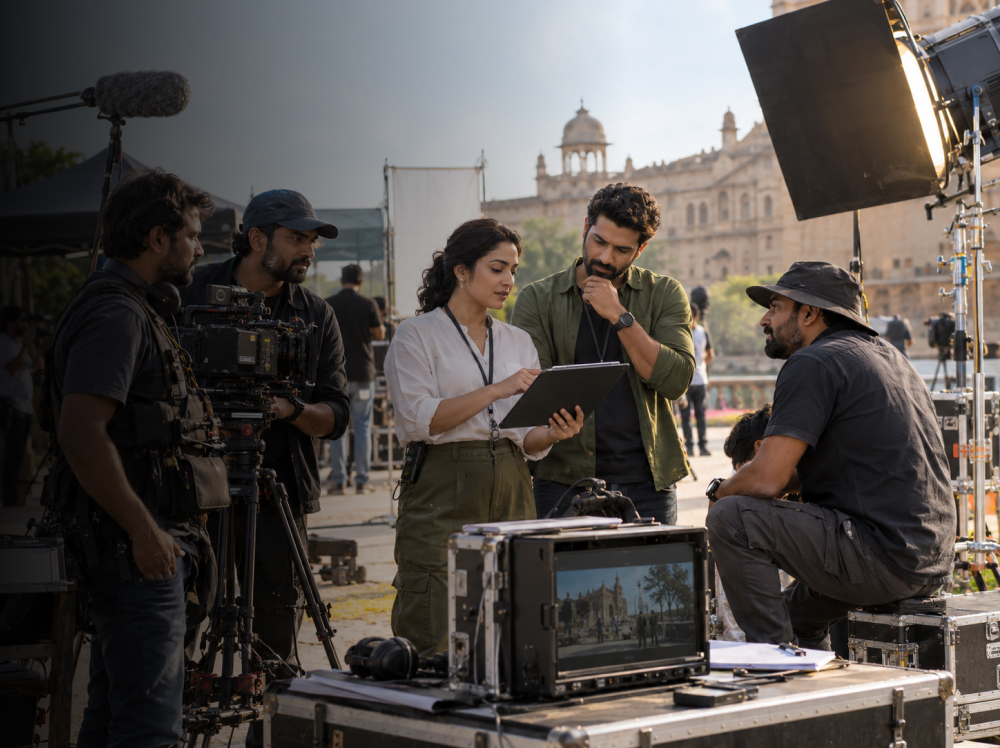
Film industry skills fall into four groups, and a career in film needs all four:
- Technical craft skills: operating your role's camera, sound, lighting or editing tools.
- Soft skills: communication, teamwork, adaptability and reliability on set.
- Business skills: agreeing terms, managing dates and earning repeat work.
- Digital, data and AI skills: media management, remote review and AI-assisted tools.
People entering Indian film and OTT work often focus on technical craft first, while communication, business and digital skills develop through experience on the job. This guide covers all four film industry skills, shows what they look like in specific crew roles on Indian productions, and explains how to check where you stand. It is written for crew and freelancers, from someone on their first unit to an assistant planning the next step up. If you are still choosing a role, start with our guide to film industry jobs.
Contents: 1. Essential skills across every role · 2. Technical skills · 3. Soft skills · 4. Business skills · 5. Digital, data and AI skills · 6. How skills change as you advance · 7. Assessing your skills · 8. Your Artisty profile · Conclusion · FAQs
What film industry skills are essential across every role?
Every role in a film or series draws on four skill groups: technical craft, soft skills, business skills and digital skills. The technical group changes completely from role to role. Soft, business and digital film crew skills apply across roles, but the specific skills and tools vary with the role and its level of responsibility. An assistant editor's digital skills center on bins and exports; a sound recordist's center on recorder settings and sound files.
| Skill group | What it covers | Example on an Indian unit |
| Technical craft | Operating the tools and following the procedures of your role | A focus puller marking an actor's positions during rehearsal so focus can be pulled accurately on the take |
| Soft skills | How you communicate, work in a team and handle pressure | Repeating the 1st AD's cues clearly on a set where the crew speaks three languages |
| Business skills | How you find, agree and keep work as a freelancer | Confirming your shoot dates in writing before you turn down another project |
| Digital, data and AI skills | Handling files, cloud tools and AI-assisted software | Backing up camera cards to two drives before a card is formatted |
India's Media & Entertainment Skills Council (MESC) publishes qualification packs that set role-specific competency standards for film and media jobs, and each pack mixes several kinds of film production skills. The Production Assistant qualification pack, for example, lists technical tasks like breaking the production schedule into a daily task list alongside generic skills like helping the team balance creative goals with the production's requirements. Filmmaking skills, in other words, are never only about the camera.
How we built this framework: the four groups of film industry skills are Artisty's own. They combine role-specific competencies from MESC qualification packs with the broader work-ready and AI skills identified by ScreenSkills, mapped to the day-to-day responsibilities of common crew roles.
Which technical skills do film professionals need?
Technical skills are the most role-specific film industry skills. They are the hands-on abilities of one role: pulling focus, placing a boom, rigging a light, dressing a set or syncing footage. Heads of department check these film production skills first, because a mistake shows up on screen. General film crew skills like "knowing the camera" are too broad to be useful; what matters is the exact task your role performs on every take.
Skills by camera, sound, art and post-production role
The table below maps core film crew skills to what each person physically does. For a fuller picture of these roles, see our guides to film production jobs in India and post-production jobs.
| Role | What they physically do | Core technical skills | Common tools |
| 1st AC / focus puller | Keeps the subject sharp on every take while the operator frames | Judging and measuring distance, marking actor positions, lens changes, building the camera | Wireless follow focus, tape measure, laser rangefinder |
| 2nd AC / clapper loader | Slates each take and manages camera media and reports | Slating, camera reports, labeling and handing over cards, marking positions | Slate, camera report sheets, media cards |
| Gaffer | Heads the electrical team and executes the DOP's lighting plan | Reading a lighting plan, power distribution, fixture choice, electrical safety | LED and HMI fixtures, dimmer boards, generators |
| Location sound recordist | Records clean dialogue on set | Setting levels, placing radio mics, monitoring noise, keeping sound reports | Field recorder, radio mics, headphones |
| Boom operator | Holds the boom mic close to the actors and out of frame | Reading the frame edge, following dialogue, managing shadows | Boom pole, shotgun mic |
| Art director | Turns the production designer's or director's brief into built and dressed sets | Drafting, scale drawing, material choice, supervising construction and set dressing | SketchUp, AutoCAD, Photoshop |
| Assistant editor | Prepares footage so the editor can cut | Ingesting, syncing sound, organizing bins, exports and turnovers | Avid Media Composer, Premiere Pro, DaVinci Resolve |
| Colorist | Grades the final picture during the DI for consistency and look | Color correction, matching shots, grading to a reference, working in a calibrated suite | DaVinci Resolve, Baselight |
| Compositor | Combines VFX layers into a finished shot | Keying, rotoscoping, tracking, paint and cleanup | Nuke, After Effects |
On some Indian productions the DOP also operates the camera instead of working with a separate camera operator. In those setups the 1st AC's focus work matters even more, because the DOP is handling framing and lighting at the same time.

Which soft skills matter on a film set?
Soft skills are the film industry skills that can most strongly influence whether a crew member is invited back, because production work is project-based and teams often reassemble. Reliability, communication and set etiquette build the trust that can lead to repeat work. The UK training body ScreenSkills lists communication, teamwork and set etiquette among the core work-ready skills for new entrants to film and TV. These transfer broadly to Indian sets, although expectations vary by production and department.
Communication, teamwork, adaptability, reliability and set etiquette
- Communication: repeat instructions back, use clear radio language, and tell your head of department about a problem before it reaches the floor.
- Teamwork: hand over cleanly at the end of a shift and help an adjacent team when your own work is done.
- Adaptability: a schedule that moves because of weather, a location permission or an actor's dates is normal. Reset without complaint.
- Reliability: arrive before your call time on the call sheet, keep your equipment ready and finish the task you were given.
- Set etiquette: stay out of the actor's eyeline, keep your phone silent during takes and never walk through a lit frame.
On multilingual productions, communicating clearly across language and department lines is a particularly useful skill.
What business skills do film freelancers need?
For many film crew professionals working project to project, a career in film depends on business skills as much as craft. Business skills are also the film industry skills often learned last, on the job. The core film production skills on the business side are agreeing clear terms before a shoot, managing your dates across projects and building relationships that bring repeat work. ScreenSkills keeps a freelance toolkit that covers the basics for film and TV.
- Agree terms in writing. Before the shoot, confirm your role, dates, working hours and credit in a deal memo or email.
- Manage your dates. Keep one calendar of confirmed and tentative dates, so you never commit to two productions at once.
- Negotiate without burning bridges. Know what your experience is worth, and discuss scope changes when they happen, not after wrap.
- Build repeat relationships. A head of department who already knows how you work can consider you for the next project more easily.
- Keep records. Save call sheets, credits, and contacts from every project. They become your proof of experience.
Which digital, data and AI skills are becoming important?
Digital skills are the fastest-changing film industry skills, and they now sit inside almost every role. AI is currently applied to specific tasks such as transcription, audio cleanup, masking, rotoscoping and pre-production planning, and its impact varies by role and production. Useful filmmaking skills in this area include managing media safely, working in cloud review tools and using AI-assisted features that speed up repetitive work.
In practice, that means copying camera cards with verification and keeping two backups before a card is reused, sharing cuts and receiving timecoded notes through online review platforms, and blocking scenes in 3D or storyboard software before the shoot. Data skills matter too: naming files consistently, tracking versions and knowing which copy is the master. In many roles these skills overlap with technical craft. AI-assisted rotoscoping is part of a compositor's craft, and AI transcription is part of an assistant editor's workflow.
ScreenSkills has published role-by-role information on AI skills for scripted film and TV, and it frames AI as a tool that supports human creativity. Treat this as an emerging trend: the tools change every year, so the lasting skill is learning new software quickly. For the roles growing fastest, see in-demand jobs in the film industry.
How do skill requirements change as film professionals advance?
Entry-level roles measure filmmaking skills on execution: doing a defined task correctly, fast and every time. More senior roles add decisions: planning the work, leading a team and protecting the director's vision within the schedule. A career in film does not follow one ladder; people specialize, move sideways between departments or switch between film, OTT and advertising. For those who move up within a craft, the shift usually looks like this.
| Track | Earlier role and its skills | More senior role and its skills |
| Camera | 2nd AC / clapper loader: slating, camera reports, media handling | DOP: lighting design, shot planning, leading the camera and lighting teams |
| Sound | Boom operator: mic placement, reading the frame | Location sound recordist: recording strategy, equipment choice, flagging sound problems to the 1st AD |
| Editing | Assistant editor: ingest, sync, organization | Editor: story structure, pacing, working with the director |
| AD team | 4th AD: running errands on the floor, managing background artists | 1st AD: building the shooting schedule and running the floor |
| Art | Assistant art director: drawings, sourcing, supervising dressing | Art director or production designer: the visual concept and its budget |
Senior film crew skills add planning and people management to the craft skills of the step below. The technical film production skills never go away; they become the base you judge other people's work against. Our guide to filmmaker jobs in India covers the senior end of these ladders.
How can you assess your current film industry skills?
The most reliable way to assess your film industry skills is to compare yourself against a written standard for your target role, then collect evidence for each skill. Use this five-step method:
- Pick one target role. "Camera" is too broad; "focus puller on feature films" is specific enough to assess.
- Find a written standard. Check the MESC qualification pack for the role, and the ScreenSkills skills checklists, which are UK-based but detailed by role.
- Mark each skill. Rate each of the filmmaking skills listed as done on a real shoot, practiced only, or not yet done.
- Attach evidence. Link each skill to credit, clip, call sheet or a senior who saw you do it.
- Close one gap per project. Ask your head of department to let you try one new task on the next shoot.
Repeat the check every few projects. Film crew skills grow in steps, and a written record shows you, and the next production, exactly where you are.
How should you demonstrate skills on your Artisty profile?
Your Artisty profile is where film industry skills become visible to productions. Artisty is a discovery and hiring platform for India's film and media industry. At every stage of a career in film, three things make your skills credible on it.
- A structured profile. KalaAi, Artisty's AI feature, maps your roles, tools and experience into a clear profile, so a production can see at a glance what you actually do.
- Verified skills. KalaAi verifies skills through a skill check and a short KalaAi interview. Pass them and your profile carries a verified badge.
- Credits and work samples. Add the projects you have worked on and a short reel or stills that show the film production skills you claim.
Describe your film crew skills specifically. "Focus puller, ARRI and Sony systems, feature and OTT experience" tells a production more than "camera professional".

Conclusion
Technical skills get you on the unit. Communication, business habits and new tools matter more with every step up in responsibility, so treat them as part of the craft from your first project. Start with one target role, measure yourself against a written standard, and turn every project into evidence. Then make that evidence visible where productions look.
Every skill in this guide is worth more when someone can see it. Take the self-check from section 7 to Artisty: KalaAi maps your roles and tools into a profile, verifies your skills through a short check and interview, and your credits and reel fill in the rest. Start your Artisty profile
Frequently Asked Questions
Do you need a degree to work in the film industry?
No single qualification is required for film crew roles in India. Many crew enter through on-set assistantships, while film schools such as FTII Pune, SRFTI Kolkata and Whistling Woods Mumbai offer structured training, industry exposure and networks. Requirements vary by craft and production, and practical experience, role-specific skills, credits and references all count when teams hire crew.
What are the most important skills for a career in film?
For many crew roles, the most useful foundation for a career in film is the technical craft of your specific role, backed by reliability on set, clear communication and the ability to manage project-based work. Technical skill gets you considered for the first job. Reliability and communication can influence whether the same head of department brings you back.
What soft skills are needed in the film industry?
The key soft skills in the film industry are communication, teamwork, adaptability, reliability and set etiquette. In practice that means arriving before your call time, repeating instructions back, adjusting quickly when the schedule changes and staying out of the frame and the actor's eyeline. These habits can influence whether a crew member is considered for repeat work.
What skills should I put on a film resume?
List the technical filmmaking skills of your target role, the equipment and software you have used on real shoots, and the projects where you used them. Name specific tools, such as a wireless follow focus, a field recorder or DaVinci Resolve. Add soft skills only when you can back them with a credit or a reference from a head of department.
Will AI change the skills film crews need?
AI is currently applied to specific tasks within film crew roles, such as transcription, audio cleanup, masking and rotoscoping. For some roles, AI-assisted tools reduce time spent on repetitive work, though the gain depends on the tool, the workflow and quality-control requirements. The lasting skill is learning new software quickly, because the tools and film industry skills around them keep changing.